Crucifix
I Am LegendThe cross is a defensive object whose apparent power over vampires becomes one of Robert Neville’s most important investigations into the difference between legend and observable fact. It first appears within the household’s improvised system of protection, but its significance changes when Neville tests it against an infected woman and later compares its effect with a torah. The result is not that the cross possesses an absolute supernatural force. Its effectiveness depends on the vampire’s religious belief, exposing the human history concealed inside a supposedly timeless rule.
Appearance and Place in Neville’s Defenses
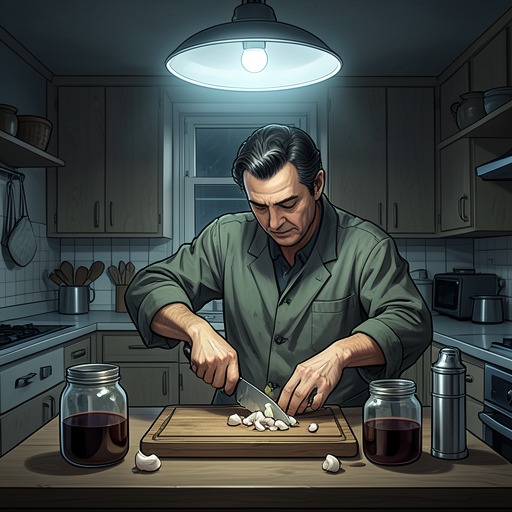
The cross belongs to the same defensive world as boarded windows, garlic, stakes, and the barricaded house. Robert Neville has already learned that garlic works, and the damaged mirror fixed to his front door is nearing the end of its usefulness; he decides that, once the glass begins to fall away, he will put garlic there instead. The cross is therefore not presented as an isolated sacred relic but as one implement among several competing methods of keeping vampires outside.
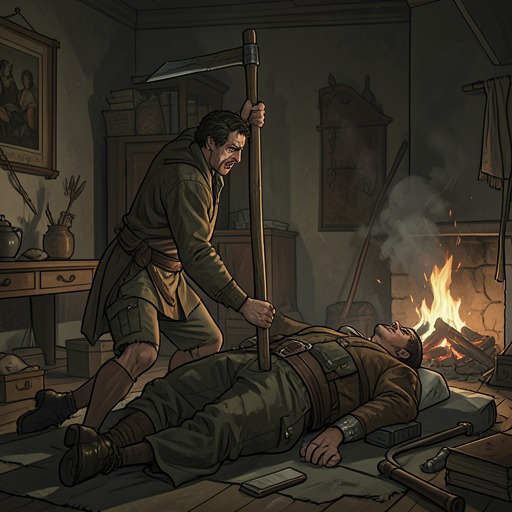
When Neville begins to question the traditional explanations for vampirism, the cross stands at the center of the problem. The observed facts seem to include the vampires’ avoidance of garlic, their confinement indoors by day, and their death by staking, while their reputed fear of mirrors and their ability to transform into bats do not survive his examination. He has seen vampire dogs, but concludes that they are infected dogs rather than animals transformed from another shape. Against this mixture of confirmed behavior and discarded superstition, the cross demands a specific test: can its effect be explained without appealing to mysticism?
Neville’s Experiment
Neville constructs a small wooden structure on the front lawn and hangs strings of onions on it, then holds a gold cross in the morning sunlight. He recognizes that the cross, too, drives vampires away, but the recognition immediately becomes a scientific question. He wants to know why it works and whether there is a logical answer that can be accepted without surrendering to the legends he is trying to dismantle.
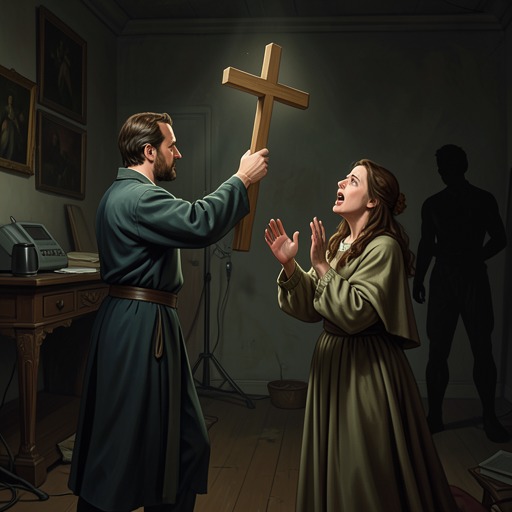
He takes an infected woman from her bed and uses her as the subject of the experiment. The choice is morally compromised from the beginning: while preparing the test, he notices that he repeatedly experiments on women and tries to dismiss the pattern as accidental. His unease is intensified by sexual tension and by the fact that the woman’s torn clothing makes her presence difficult for him to ignore. He binds her to a chair, isolates himself in the garage during the afternoon, and waits until night before placing the cross directly before her.
When her eyes open, she reacts immediately. She jerks her gaze away, twists against the chair, and recoils when Robert Neville swings the cross before her face. He demands that she look at it, but her terror produces only gasping and whining. When she attacks him, her teeth leave raw wounds in his hand; he strikes her across the cheek, then throws her body out through the front door ten minutes later. Outside, the vampires fight over the remains, while Neville stands against the door, breathing heavily. The experiment thus yields practical evidence, but it also reveals the violence required to obtain it and the emotional pressure that makes his supposedly rational method unstable.
Religious Belief Rather Than Universal Power
The cross’s apparent universality collapses when Neville discusses it with Ruth. She explains that, in protecting her former home, her people used boarded windows, crosses, and garlic. Neville has already observed that crosses do not always work, and Ruth confirms that garlic was also part of their defenses, although her illness had made her dangerously thin. Her testimony places the cross within ordinary survival practice rather than treating it as an automatically effective weapon.
Neville then recounts an encounter with Ben Cortman. When he held a cross before Ben Cortman, the vampire laughed at him. A torah, however, produced the desired reaction: using it, Neville forced Ben Cortman backward and drove him out. This contrast supplies the explanation Neville has been seeking. The relevant object is not simply a cross-shaped piece of material; it is the religious symbol that the particular vampire recognizes and fears.
Neville’s theory is that the legend developed in Europe, a predominantly Catholic continent, so the cross naturally became the established symbol of defense against the powers of darkness. The torah works against a Jewish vampire because that symbol carries the corresponding authority for him. The rule is therefore culturally situated. What appears in folklore as a metaphysical property of the cross is, in practice, an effect mediated by memory, belief, and religious identity.
Symbol, Observation, and the Collapse of Legend
The cross marks the boundary between Neville’s inherited vocabulary and his emerging scientific understanding. He is willing to retain whatever observation confirms: garlic repels vampires, sunlight kills many germs, and staking produces death. At the same time, he rejects claims that do not withstand direct scrutiny, such as invisibility in mirrors or transformation into bats and wolves. The cross remains in an intermediate position because its effect is real but its explanation is not the one supplied by popular legend.
Its force also depends on a paradox. Neville uses the cross as an instrument of empirical inquiry, yet the object works through the beliefs of those who confront it. Science does not simply erase superstition; it discovers that superstition has been recording a distorted version of a psychological and cultural mechanism. The object’s material form matters less than the meaning projected into it by the vampire.
The cross consequently participates in the novel’s larger movement from folklore toward biology and social explanation. Neville’s later realization that bacteria can mutate further undermines any stable boundary between supernatural category and natural process. The cross does not explain the disease, but its conditional operation teaches him that the vampire tradition contains observations, errors, and cultural substitutions rather than a single coherent supernatural law.
Narrative Significance
As an object, the cross changes from a defensive talisman into evidence. It protects Neville in an immediate encounter, but its greater importance lies in the distinction it forces him to make between a rule that works and an explanation that is true. Its failure before Ben Cortman, followed by the success of the torah, turns a familiar horror convention into a study of identity and interpretation.
The cross also exposes the limits of Neville’s detachment. He approaches the infected woman as an experimental subject, but the scene brings together fear, sexual repression, physical violence, and the burden of solitary survival. His scientific ambition does not place him outside the world of ritual; he continues to use symbolic objects while trying to translate their effects into rational terms. The cross therefore stands as both tool and contradiction: a relic of vampire legend that becomes most intelligible when legend is understood as culturally conditioned human behavior.